There are many ways to use dogs in therapeutic settings. Providers are only limited by their imagination. Here are a few suggestions in which trained dogs may be helpful.
Emotional Support Service Dogs
An emotional support service dog is a dog that has been trained to perform certain tasks to help it’s disabled owner experience a more normal life. The key words here to qualify the dog as a service animal are “trained to perform a task” and “disabled”. In order to qualify as a service dog with the rights of access guaranteed by the Americans With Disabilities Act, the dog must be trained to do things that the disabled individual needs in order to more easily function in life.
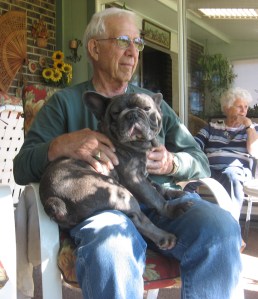 Examples of a trained emotional support service dog are reconnaissance dogs (dogs who walk ahead of their person in order to intercept people who may be hidden from view; dogs who alert their person to people who may be hiding in a room, and dogs who offer a physical boundary between their person and the public.)
Another type of emotional support service dog is the anchor dog. This type of dog has been trained to physically anchor a child with 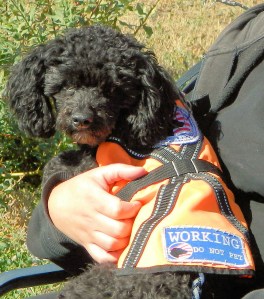 autism to a room or building. Children within the spectrum of autism who cannot be confined through locks on doors or windows can be physically tethered to their service dog. The trained dog knows not to leave a certain area and will bark a warning to allow a parent or care-giver to intervene and relock doors when and if the dog is forced outside of the designated safe area.
Dogs who give comfort to an emotionally fragile individual by their presence alone may not qualify as a service dog. These dogs, as beneficial as they are, may only have the designation of therapy dog, which does not give them legal access to public places which would otherwise be off limits to dogs.
Emotional Support /Social Facilitating Therapy Dogs
An emotional support therapy dog is a dog whose presence gives comfort to an individual and makes life and interaction with people more manageable. An example of an emotional support therapy dog is a dog whose presence helps a person with social anxiety more easily cope with being in public.
A social facilitating dog may be a dog who accompanies a small child with a disability in public places creating the focus more so on the dog as opposed to the child’s disability.
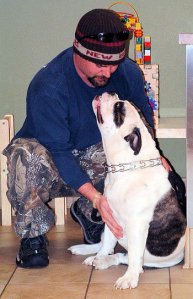 Very shy individuals may also benefit from an outgoing, friendly dog, again, putting the focus on the dog instead of the shy individual.
There really are so many ways that a well-behaved, obedience trained dog can be helpful to shy or anxious people and children with emotional or physical disabilities that a whole chapter could be devoted to just this type of dog.
Resident Nursing/Rehab, and Psychiatric Facility Therapy Dog
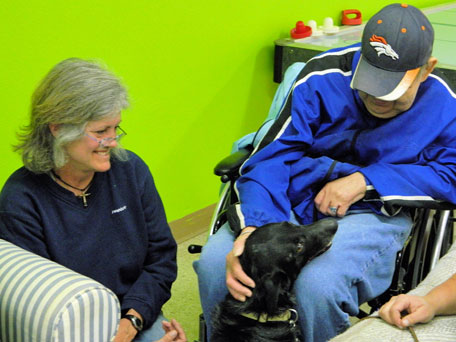
For many years, studies have shown that people live happier, healthier lives when they have the companionship of a pet. Nowhere is this more true than in a residential, therapeutic setting.
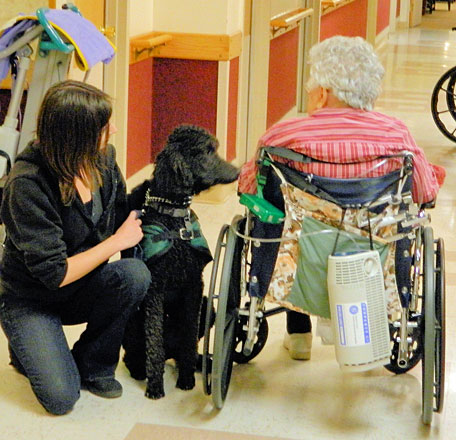
The resident therapy dog can live at the facility or can go home with a staff member. The dog should have a low to medium energy level, a great tolerance for unusual sights, sounds and apparatus (beeping machinery, wheel chairs, gurneys, etc.) and above all, a deep affection for all people.
Minimal Training: Basic Obedience.
Personality/Temperament: Tolerant, quiet, likes everyone.
Courtroom/Victim’s Advocacy
A victim’s advocate dog is a dog who is used to soothe the fears and anxiety of both adults and children who must testify against people who may have harmed them. Usually allowed only in a waiting area, a well-trained, calm dog is sometimes allowed into the actual courtroom. Children, especially, may have an easier time talking and answering questions with a friendly dog by their side. The physical act of touching and petting the dog while being questioned can help ground the individual and help them answer questions.
Minimal Training and temperament: A dog who will actually go into the courtroom must have advanced obedience skills and be a quiet, well-behaved member of the court. Dogs who will be used in a waiting room only can possess less skill but must still be quiet and well-behaved.
Counseling/Social Work
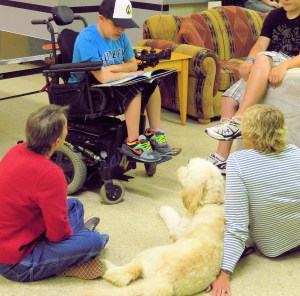 For many years, dogs have been used to help counselors put people more at ease and to encourage communication. Children, especially, are more forthcoming when they can talk to a dog. Therapists using dogs in their practice have one more tool to add to their repertoire when it comes to helping people overcome trauma, talk about fears, or seek help in coping with stress. Dogs being used in individualized treatment plans can be small enough to hold in a lap or big enough to sit next to someone while being petted. The requirements for a dog to be used as a therapy dog in a clinical setting are that the dog be quiet, gentle, well-behaved, and enjoys interacting with people, even if the people are upset.
Minimal Training: Some obedience.
Personality/temperament: Must like people and have a happy outlook.
Trauma Response Teams
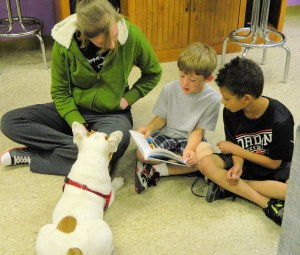 Disasters such as flood, hurricane, earthquake, and fire. Terrorist strikes such as the Boston bombings and school shootings leave many victims. Not only are the people who have been directly affected by the disaster or mass shooting left in shock with lives shattered, but the first responders are often also left deeply affected with life changing experiences and visions of trauma and mayhem. Trauma response teams are specially trained individuals who converge on the scene in the aftermath of disaster to help the survivors and first responders cope with what has happened. Teamed with their gentle, accepting, canine partners, the trauma response team helps heal where no bandage can reach.
Minimal Training: Basic Obedience (advanced obedience helpful in some instances, depending on the situation)
Personality/temperament: Dogs should be sweet-natured but resilient. They, too, will experience trauma. They may smell blood, fear, explosives. There will be chaos. They shouldn’t be asked to work longer than their individual personalities can handle.
Funeral Home
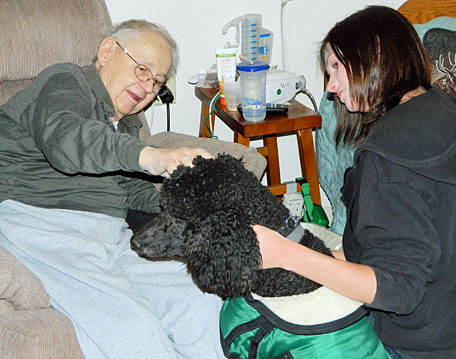
The loss of a loved one is perhaps the single worst event in someone’s life. Getting through the ordeal of paperwork, choosing arrangements and then experiencing the funeral may be easier with the addition on staff of a resident grief therapy dog. This well-trained, friendly and quiet dog, may live at the funeral home full-time, sweetly lending support to anyone whose life has been forever changed by the loss of a loved one.
Minimal Training: Basic to advanced obedience with an emphasis on working via handsignals.
Personality/Temperament: Sweet, gentle, quiet and loving.
 Colorado Pro Paws LLC